Stream-Turned-Torrent Forces Freezing Night Out
They were five friends tackling the advanced Rees-Dart Track in Mt Aspiring National Park. For four of them, including Roger and his partner, it was a long-awaited chance to tick the track off their wish list. The fifth, who had never been tramping before, was just keen for an adventure.
They certainly got one. When a stream came up, the group found themselves huddled together under a rock ledge, facing a freezing night and hoping they could keep warm enough to avoid hypothermia.
It was a steady, light rain when the group set off from Shelter Rock Hut to Dart Hut on day two of their trip. There had been rain overnight, but there were no unbridged river crossings on the route, and only small stream crossings that day, so they weren’t worried.
When they reached the stream, just 500 m short of Dart Hut, they were stunned by what greeted them.
“The stream was too swollen to be safe to cross,” says Roger. “The shocking thing for us was that this was a small side stream that you could almost step over on a normal day.”
Despite their better judgement, the group decided to attempt a crossing.
“We gave it a crack. It was foolish but we were ignorant about river crossings and desperate to get to the hut. It had been a long, cold day and we were totally unprepared to spend a night out,” says Roger. “We quickly realised that we weren’t going to make it. The stream was really moving, and we knew if we fell, we’d probably be swept into the Snowy Creek, which was absolutely roaring.”
Partway across they made the call to turn back, but without solid knowledge of the mutual support method, the safest way to cross a river as a group, things took a turn for the worse.
We turned around, but our technique wasn’t good, and on the way back, one of our team lost his footing and was swept off his feet. The flow was so strong that all he could do was hold on to us for dear life while we dragged him back to the shore. Somehow, we all made it back, but it was a terrifying moment and one that will be burned into my memory for life– says Roger.
Wet through and shaken, they were left with no option but to wait for the water levels to drop, but that raised other concerns.
“It was a worrying situation. It was quite late in the day, and we had no tents or sleeping mats with us. It was very cold and one of our team was clearly developing hypothermia.”
Several hours passed, but the stream showed no signs of dropping, and they became worried about surviving a night out above the bush line and with no shelter. After discussing their options, they decided the safest decision was to activate their personal locator beacon.
“We naively thought that a heli would shortly swoop in and save the day,” says Roger. “Unfortunately, the cloud was so low that there was no way the heli could get up the valley, so we were there for the night.”
Scouting around the area, they were lucky to find a rock overhang that was large enough for all of them to shelter under with their knees and below exposed. They were able to change out of their wet clothes and get mostly dry, but it was a cold, miserable night.
“Miraculously we survived, but it was without doubt the coldest I have ever been,” says Roger. “In the morning the puddles were all frozen and the surrounding peaks had a dusting of fresh snow, and we all felt grateful to be alive.”
At first light, the helicopter arrived.
“We felt a bit embarrassed to tell the rescue crew that we didn't really need them anymore. The sun was out and the stream had reduced to a trickle,” says Roger. “But in the end, we got a lift out to Kinloch as we were all pretty traumatised by the whole ordeal.”
Roger’s key learning
This experience showed me that an emergency shelter can be a lifesaver. I now carry a tent, along with a sleeping mat, on all trips, even for well-established tracks with huts. This takes the pressure off ever feeling I have no choice but to cross a river.
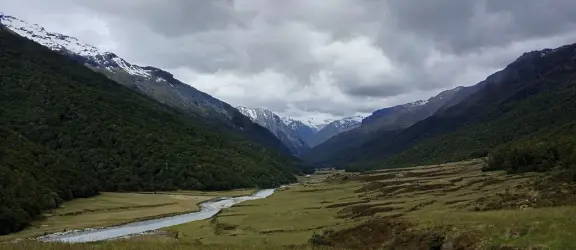
PHOTO CREDIT | Hamish Low, Plan My Walk | Rees-Dart Track
Last edited: September 2026