Wrong Boots Lead to Crampon Failure on Taranaki Climb
It was Queen’s Birthday weekend when Jon decided to take on a more ambitious mountaineering objective than he’d initially planned. This spur-of-the-moment decision led to a critical equipment failure and near miss on one of New Zealand’s most dangerous peaks.
Jon left Auckland heading toward the East Coast with his plan to climb Maunga Hikurangi in the Raukumara Conservation Park. But when he checked the forecast and saw the weather was deteriorating, he switched course to the west coast and the more challenging Taranaki Maunga summit climb via Syme Hut in Te Papa-Kura-o-Taranaki.
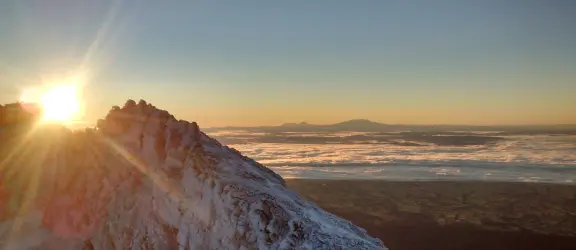
The conditions were clear and calm when he set off from the car park, planning to walk through the night for the sunrise at the summit. He reached the hut at around 11 pm, snatched a couple of hours’ sleep, and then continued up the rocky slopes. The rock eventually gave way to icy terrain, becoming treacherous rime ice the higher he went.
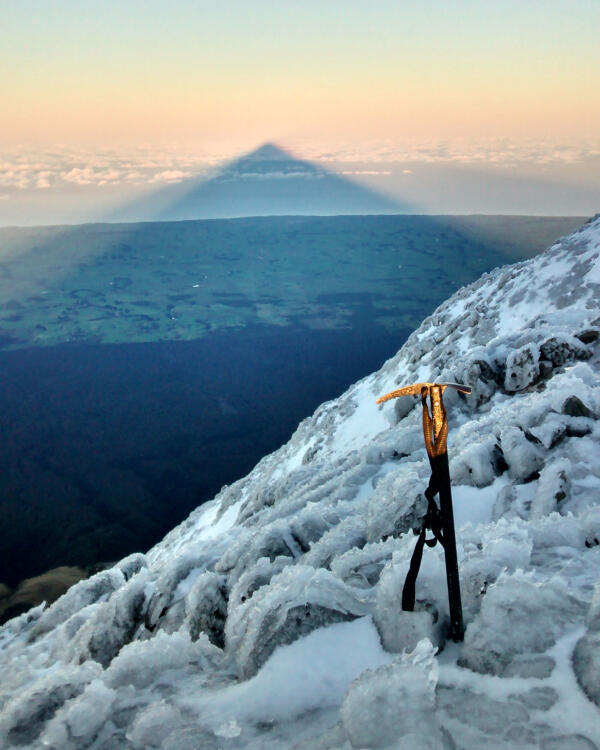
Taranaki Maunga has a reputation for rime ice surface conditions. This ice can become smooth and dense, offering very little grip for crampons or an ice axe, and adding additional stress on boots and ankles.
Jon’s original plan involved an overnight tramp with a comparatively minor scramble, so he wasn’t equipped for the mountain’s conditions. While he had an ice axe and crampons with him, he was only wearing three season tramping boots. These have a flexible sole so are not typically compatible with crampons, which generally require rigid mountaineering boots.
That was almost his downfall. Unbeknown to Jon, one of the crampons was slowly becoming detached from his boot as he made his way up the slope until it was eventually being held on by the strap alone.
Several metres below the summit, the combination of rime ice and crampon malfunction caused him to lose traction.
“As I went to drive my points into the ice, I felt my foot skid and slip off the surface. If I hadn’t checked my slip, there would have been no chance of self-arresting on that infamous rime ice.”– says Jon
That left him in a precarious position.
“I knew I needed to steady myself, so I chopped a handhold with my axe, and then holding onto that, was able to chop a foothold, so I could relax a little. Once I stopped shaking, I chopped out a seat and sat down to investigate and fix my crampon. I set off again rather gingerly, checking my crampons in the headlamp beam almost constantly so the same thing didn’t happen again.”
Twenty minutes later, he reached the summit in time to see the sunrise unfold, but it was a short respite from the high-risk descent ahead of him.
“My down climb was slow and methodical. I paid almost constant attention to the state of my crampons,” says Jon. “I only felt I could finally relax once I was back at Syme Hut having a hot brew.”
Jon knows all too well the mountain's reputation and the severity of his situation. He hopes his story will serve as a warning to others to plan ahead and have the right gear for the objective.
“ I had luck on my side that morning, and I’m fully aware that it could have been a much different outcome.”
Jon’s Key Learning
Plan ahead, even if you change your plans. Always research your new objective and check that your gear is appropriate.
Take suitable gear. A lack of adequate gear for the conditions was the key contributing factor to the high-risk situation I found myself in.
Have the skills for the objective: Having the mountaineering skills, in particular, knowing how to cut holds got me out of a tight situation.
Stay calm. I didn’t panic. Keeping a level head and problem-solving in the heat of the moment got me through safely.
Be aware of mental shortcuts. Don’t let commitment to a goal prevent good decision-making. I should have turned back when I realised that there was rime ice on the climb.
NZ Mountain Safety Council Advice for Taranaki Maunga
- Treat Taranaki Maunga as a mountaineering climb not a tramp. If you don't have mountaineering skills, experience and gear, only consider the summit climb between January and April via the Taranaki Maunga Summit Track, and only when there is no snow or ice.
- Have the appropriate skills and experience before you go. Know how to use crampons and an ice axe, recognise hazardous conditions, travel safely on steep terrain, and make sound decisions to avoid slips.
- Use equipment that is appropriate for the conditions. Rigid mountaineering boots with compatible crampons, a helmet and an ice axe are essential gear when snow and ice are present.
- Know your limits – and the mountain's. Experience gained on other mountains does not necessarily prepare you for the unique conditions on Taranaki Maunga. Get local advice, continually assess conditions and be prepared to turn around if it becomes unsafe.
- Check Plan My Walk for the weather forecast and any alerts before you go.
- Check the NZ Avalanche Advisory for the latest information on avalanche and snow conditions, including sliding hazards.
- Be prepared to change your plans if the weather looks bad or conditions make climbing unsafe.
PHOTO CREDIT | Taranaki Maunga Summit, Jon
Last edited: October 2026