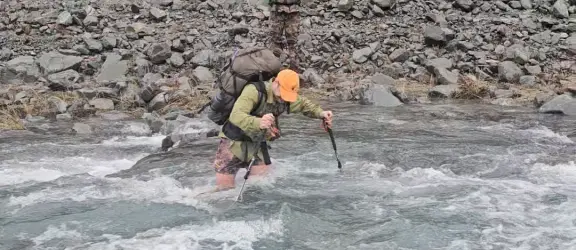
Knowing When Not to Cross a River: A Hunter’s Tale
Hunter Daniel Lastovicka explains how knowing the signs of an unsafe river led to the best decision he has ever made in the hills and ended with him and his mates driving home without firing a shot.
Last year I walked into a valley with my mates Mike and John. A weekend on the tops, nothing ambitious. We never made it to the hunting spot.
The river crossings started manageable and got worse. We took them one at a time, individually, and each one we could just about handle on our own.
I would once have offered that as a compliment to the three of us. It is not one. ‘Just about’ is not a margin. What it actually describes is a run of crossings each fractionally harder than the last, with three of us privately assuming the others were comfortable because nobody had said otherwise, but we were committed for all the wrong reasons.
With all of us focused on the end goal, nobody wants to be the one who calls it. It’s fair to say we had fallen into the commitment mental shortcut or heuristic trap. So, the water creeps further up your legs, the bar for what counts as acceptable creeps up with it, and you keep going, largely because you kept going at the last one.
Then we came to one we could not cross.
A couple of years earlier I would have stood there and started working out how to make it happen. I know that, because I had done exactly that on a tahr hunt in the Rangitata, and spent a night in a hut waiting on a helicopter as a result.
What I have learned since is that the river tells you if you are willing to be told. NZ Mountain Safety Council reduces the whole assessment to four simple questions, and you can usually answer all four from 20 metres away.
- Too fast? A river worth considering moves no quicker than walking pace. Time a stick through a measured stretch if you are not sure.
- Too murky? If you cannot see the bottom, you cannot see the depth, the holes or the boulders you are about to put a foot between.
- Too messy? Debris in the flow tells you the water is strong enough to be tearing things off the bank or sending large branches your way.
- Too loud? Roaring water and rocks rolling underneath it mean the river is rearranging its own bed.
If you answer yes to any of these, you stay out. If in doubt, stay out is not a soft option for people short on commitment. It is the entire skill.
Two more questions are worth asking, and they are about the party rather than the water. Is everyone here actually comfortable or has nobody wanted to say otherwise? And am I stepping in because I have assessed this crossing or because the bloke in front of me just did and he’s the ‘expert’? Fail to answer these questions, and you’ve got the perfect example of the expert heuristic trap in action.
The difference between this hunt and others was that I did not spend any time trying to solve this river crossing puzzle. Why? We were still on the walk in. We had no animals, no meat and no reason to be on the far bank beyond having planned to be. The only thing that river could cost us right in that moment was a weekend and a tank of fuel.
On this occasion, we talked it through as a team and decided together to throw in the towel, walk back to the truck and come back another weekend. Nobody needed to call a helicopter. Nobody's wife got a message from a satellite device. It was the least eventful trip I have had in the hills and is the one I am most pleased with.
A hunt you walk away from costs you fuel and a Saturday. The hills are not going anywhere and neither are the animals.
Names have been changed for the purposes of this story.
PHOTO CREDIT | Daniel Lastovicka
Last edited: October 2026